
Educational card games can turn learning into a fun and engaging experience for 5th graders. The best educational card games for 5th graders promote essential skills like math, geography, and critical thinking. Furthermore, it also creates opportunities for family bonding and social interaction.
From exploring global cultures in The World Game to understanding anatomy in Organ Attack. These games transform education into an enjoyable experience. In this article, we’ll dive into 5 fantastic educational card games. It can enhance your child’s learning experience while keeping them entertained.
Here’s a detailed look at 5 top educational card games. It can help children develop important skills while having a great time!
Top 5 Best Educational Card Games for 5th Graders
1. The World Game
The World Game is an exciting and educational card game. It focuses on geography, culture, and global awareness. Players learn about different countries while enjoying competitive gameplay.
It is perfect for families, friends, and educators, this game combines learning with entertainment. This is a fantastic choice for 2-6 players aged 8 and up. The components of the game include cards featuring countries, capitals, flags, and facts.
The game encourages interaction and discussion. Therefore, it is an excellent tool for casual play and educational purposes. Furthermore, it also promotes critical thinking. This game can be played in larger groups. It is suitable for family, classroom, or social gatherings.

Pros:
- Promotes learning about geography.
- Encourages critical thinking and memory skills.
- Engaging for both kids and adults.
- Great for family game nights.
- This game encourages conversation and teamwork.
- It has diverse gameplay.
Cons:
- May require adult supervision for younger players.
- Some cards may be too difficult for beginners.
How to Play:
- Shuffle the deck and divide five cards for each player.
- Players take turns asking questions about the cards in their hands.
- If a player answers correctly, they keep the card; otherwise, it goes back to the deck.
- The game continues until all cards are collected or a set time is reached.
- The player with the most cards at the end wins!
2. 5 Second Rule
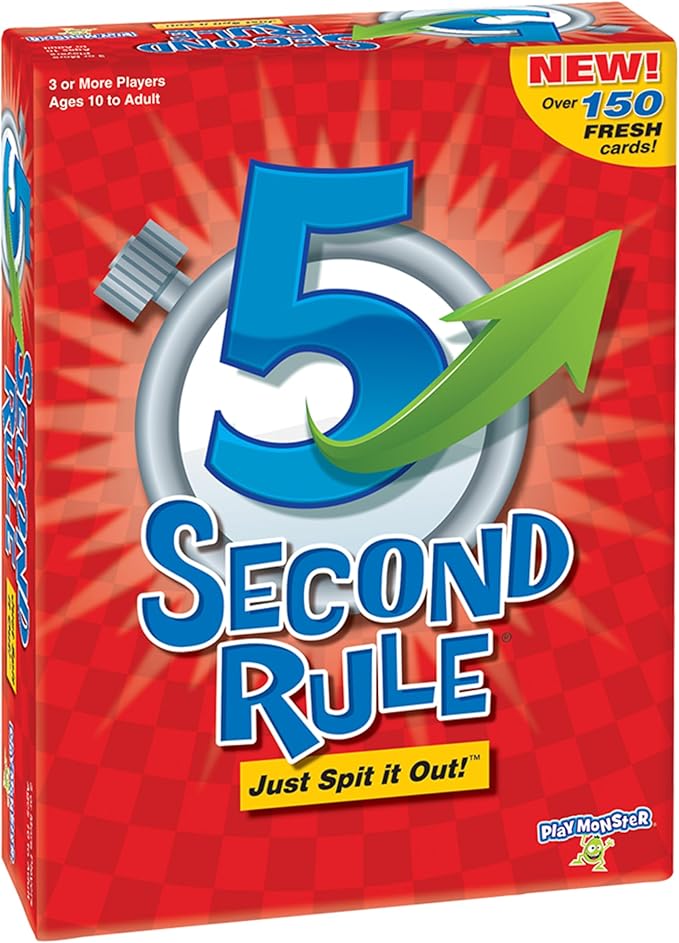
5 Second Rule is a fast-paced and engaging card game. It challenges players to think quickly and speak even faster. Players must name three things from a given category in just five seconds. It promotes quick thinking, fast responses and decision-making skills.
This game is ideal for 5th graders. It helps develop verbal skills, enhances critical thinking, and encourages social interaction. Furthermore, it is perfect for family game nights or classroom activities.
The quick-thinking party card game is suitable for 3-6 players, ages 10+. Additionally, it features 576 category cards which divided into various topics. It also contain a scoring board, and timer for five-second tracking.
Pros:
- Promotes quick thinking and verbal skills.
- Fun for players of all ages.
- Easy to learn and play in large groups.
Cons:
- May be too challenging for younger children.
- Fast-paced nature might lead to stress for some players.
- Some children may feel stressed by the time limit.
- It requires Verbal Skills.
How to Play:
- First, Gather all players and decide the order.
- Shuffle the category cards and place them face down in a pile.
- Players take turns drawing a category card.
- The player reads the category aloud (e.g., “Name three types of fruit”).
- Start the timer and give the player five seconds to respond.
- If they succeed, they earn points; if not, they pass the card to the next player.
- The player with the most points at the end wins!
3. Organ Attack
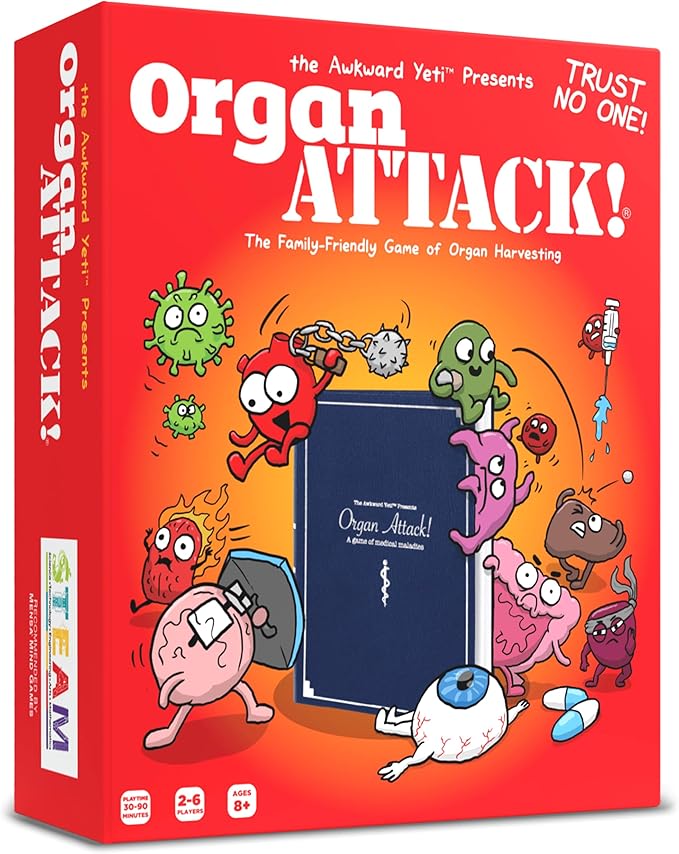
Organ Attack is an innovative and engaging educational card game. It is designed to teach kids about the human body, specifically focusing on organs and their functions.
This game develop knowledge about anatomy. However, it also emphasizes the importance of health and wellness. It combines fun gameplay with educational content. This makes it ideal for parents and educators looking to enhance children’s learning experiences.
The game is for 2-4 players aged 8 and up. Furthermore, the game consists of organ cards, condition cards, a game board, and an instruction manual. Organ Cards represent different organs (e.g., heart, lungs, brain) and their functions.
Condition Cards describe various health conditions and events that can affect the organs (both positive and negative). Game Board illustrates the human body and provides a visual representation of the organs.
Pros:
- Teaches kids about anatomy and health in a fun way.
- Encourages strategic thinking and planning.
- Engaging visuals and gameplay keep kids interested.
- Promote healthy habits, teamwork, and communication among players.
Cons:
- May require adult supervision to explain concepts.
- Some conditions might be too complex for younger players.
- Its effectiveness depends on group size, making solo play unfeasible.
How to Play:
- Shuffle the organ and condition cards separately.
- Each player receives a set of organ cards representing different body parts.
- Players draw condition cards that can affect their organs (both positively and negatively).
- Players must discuss how the condition impacts their organs. For example, a condition card might say, “Your heart has to work harder due to poor diet.”
- Use strategy to protect your organs from damage while attempting to sabotage opponents.
- The player with the healthiest organs at the end of the game wins!
4. Sleeping Queens
Sleeping Queens is a delightful educational card game. It is created by a young girl named Miranda. In this game, players aim to awaken sleeping queens by using strategy and a little bit of luck. It teaches essential skills such as critical thinking, basic math, and social interaction. It is a perfect fit for 5th graders.
Educational benefits of sleeping queen include improving math skills through simple addition and subtraction, strategic thinking through decision-making, and developing memory and recognition through tracking queen awakenings and opponent cards.
The game features 2-5 players aged 8 and up, with luck elements, 79 playing cards, and instructions for gameplay.

Pros:
- Encourages strategic thinking and basic math skills.
- Engaging and colorful artwork.
- Suitable for family game nights.
Cons:
- May be too simple for older kids or adults.
- Gameplay can be slow if players take too long to decide.
How to Play:
- Shuffle the cards and set up the queens face down in the center.
- Players take turns drawing cards and trying to wake queens by playing number cards.
- Use special action cards to steal, protect, or put queens back to sleep.
- The first player to collect a predetermined number of queens wins!
5. Qwixx
Qwixx is a fast-paced and engaging dice game. It is a combination of luck and strategy. The game is designed to enhance players’ arithmetic skills while providing a fun and competitive environment. With its simple rules and engaging gameplay, Qwixx is perfect for family game nights or classroom activities.
It is dice rolling and number-marking game. Players of ages 8 and up can play this game with 2-5 players. The package includes 6 dice (2 white and 4 colored), a score pad, and a rule booklet.
Qwixx enhances math skills, critical thinking, quick reflexes, and social interaction. It is perfect to make strategic decisions, and engage in communication and teamwork.

Pros:
- Encourages quick thinking and basic math skills.
- Easy to learn and play.
- It is suitable for family game nights.
- Fast-paced gameplay keeps all players engaged.
Cons:
- Limited interaction between players may reduce social engagement.
- Some players may find it repetitive after multiple rounds.
How to Play:
- At the beginning of the game, each player receives a score sheet and a pencil.
- Players take turns rolling the dice.
- After rolling, the player can choose to mark a number on their sheet that corresponds to the total of the two white dice.
- Alternatively, players can choose to mark off numbers in the colored rows based on the values of the colored dice.
- Players earn points by marking off numbers.
- Completing a row earns bonus points.
- The game continues until a player has marked off enough numbers to trigger the end of the game.
- The player with the highest score wins!
FAQs
1. What’s the most common card game played by kids?
The most common card game played by kids is Uno. It’s easy to learn and fun for all ages. Players take turns matching cards by color or number, trying to be the first to get rid of all their cards.
2. What is the funniest card game?
The funniest card game can vary by preference, but many people enjoy Exploding Kittens. It’s a silly and fast-paced game where players try to avoid drawing an “exploding kitten” card while using strategy and humor to win.
Read More: Exploding Kittens Card Game Review: Is It Worth the Investment?
3. What is 4 a kind 3 of kind card game?
The 4 of a Kind 3 of Kind card game refers to a variant of poker where players try to make the best hand possible. A “four of a kind” means having four cards of the same rank (like four Aces), while a “three of a kind” means having three cards of the same rank (like three Kings). Players win by having the highest-ranking hand at the end of the game.
Conclusion
In conclusion, Incorporating the best educational card games for 5th graders into your child’s routine can significantly enhance their learning experience. Games like The World Game and Qwixx make education fun. Furthermore, it promotes important skills like teamwork, strategy, and problem-solving.
Whether your child is mastering geography, sharpening math skills, or exercising their creativity, these games provide valuable growth opportunities. Explore these exciting options today and turn learning into an enjoyable adventure that your child will love!